Buyers often compare earthmoving equipment on price before they compare it on duty. The sections below set out what the duty actually involves for a civil contractor working on road packages working with crushed basalt, and where cost is really created. The reference case is a a plant yard operation in Kenya.
The operating context matters as much as the machine specification. In Kenya, a civil contractor working on road packages works in a warm highland climate with a pronounced dry season. A plant specified for this market normally includes dust control at the transfer points and a water supply sized for both mixing and spraying, and the layout is planned around crushed basalt rather than a generic aggregate.
Wheel loader sizing for aggregate yards
Loader size should match the batching machine hopper and the distance from the stockpile. A bucket that fills the hopper in two passes is more efficient than one that requires four, and a shorter travel distance allows a smaller machine to keep up.
Bucket capacity quoted in cubic metres refers to heaped volume. Real payload depends on material density: a bucket of sand weighs considerably more than the same bucket of lightweight aggregate. Check the rated load against the densest material on site.
Backhoe loaders on mixed sites
A backhoe loader can dig foundations, load trucks and handle materials with one machine and one operator. For a plant yard that also carries out small civil works, that flexibility reduces the total fleet size.
The compromise is that a backhoe loader is not the best at either task. Digging depth and breakout force are lower than a dedicated excavator, and loading output is lower than a wheel loader of similar power.
Machine
Best for
Limitation
Wheel loader
Feeding bins, yard work
Poor on soft or uneven ground
Backhoe loader
Mixed digging and loading
Lower output than dedicated units
Excavator
Bulk digging, quarry face
Needs a trailer to relocate
Skid steer
Cleaning between structures
Limited reach and payload
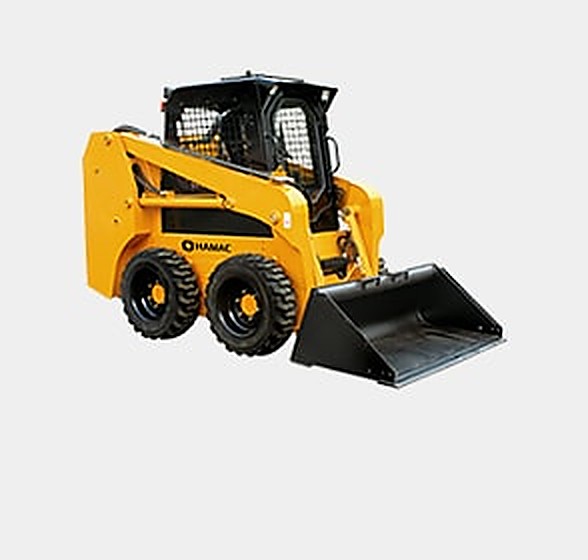
Skid steer loader cleaning a concrete plant yard — HAMAC equipment supplied to concrete and aggregate projects worldwide.
Excavator selection for quarry and foundation work
Excavator selection starts with the bucket and the material. A narrow bucket suits trenching, a wide bucket suits bulk excavation, and a breaker attachment turns the machine into a primary reduction tool. Operating weight and hydraulic flow decide which attachments can be used effectively.
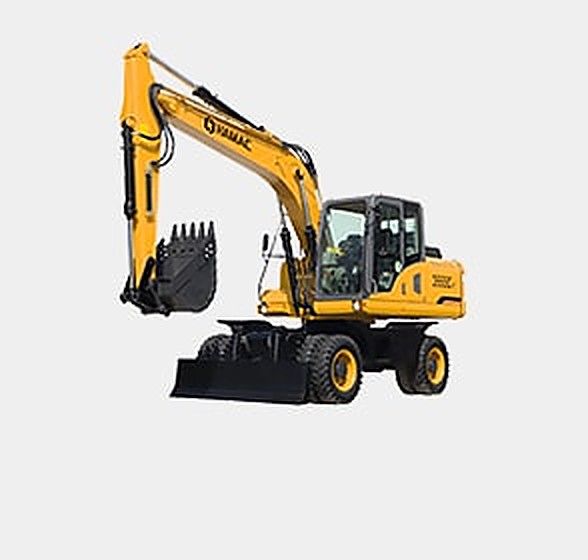
Undercarriage choice matters as much as the upper structure. Tracked machines suit soft or uneven ground, while wheeled machines move between sites without a trailer. On a fixed plant site with hard surfaces, a wheeled excavator can be the more economical choice.
Attachments that extend machine use
A skid steer loader with a bucket, forks, sweeper and breaker can handle most yard cleaning and material handling tasks. Its small size allows it to work inside plant structures and between stockpiles where larger machines cannot reach.
Attachment standardisation is the practical issue. A quick-coupler system that matches the attachments already on site avoids buying duplicate tools and reduces changeover time.
Wheeled excavator preparing a foundation for a batching plant — HAMAC equipment supplied to concrete and aggregate projects worldwide.
Fuel, tyres and operating cost
Fuel and tyres typically account for the largest share of an earthmoving machine operating cost. Tyre life depends on surface condition and load: a yard with sharp aggregate spillage will destroy tyres quickly unless the surface is kept clean.
Idling is a hidden cost. A loader waiting for a truck with the engine running burns fuel without producing work. Scheduling deliveries and loading patterns to keep machines working steadily reduces consumption more than any small change in engine specification.
Safety around plant and stockpiles
Stockpile stability is a real hazard. Undercutting a stockpile face can cause a collapse onto the machine or the operator. Keeping the face angle within the material angle of repose and never digging at the toe of a stockpile are basic rules that are frequently ignored.
Traffic management between loaders, trucks and pedestrians is the other major risk. A one-way route, defined crossing points and a clear rule that pedestrians never enter the loading area prevent the most common accidents on concrete plant sites.
Maintenance for dusty environments
Air filters, cooling packs and hydraulic breathers are the parts most affected by dust. Cleaning the cooling pack daily in dry conditions prevents overheating, which is the most common cause of unplanned downtime in hot climates.
Greasing points on pins, bushes and the bucket linkage should follow the manufacturer schedule and be increased in wet or dusty conditions. A pin that runs dry wears quickly and the repair cost is far higher than the grease it needed.
Where to go next
For the equipment side, see earthmoving machines; for plant-level design and layout questions, see project references. If the project is in Kenya or a comparable market, the HAMAC team can provide reference installations and a configuration proposal against your daily output target.
Send the daily volume, mix types and site conditions to HAMAC engineers and you will receive a configuration and a quotation, normally within one working day.
Need help applying this to your project?
Send your material type, target output and site conditions to HAMAC engineers. You will receive a practical equipment configuration and a clear quotation, normally within one working day.
Questions about this topic
Is a wheeled excavator suitable for a fixed plant site?
On hard surfaces, yes. It moves between tasks without a trailer and causes less surface damage than a tracked machine.
What size wheel loader do I need for a batching plant?
For a 60 m3/h plant with stockpiles within 30 metres, a 3 tonne class loader is normally adequate. Longer travel or a larger plant calls for a 5 tonne class machine.
How do I stop tyre damage in an aggregate yard?
Keep the yard surface clean and level, avoid turning on spilled aggregate and use the correct tyre for the surface. Sharp spillage is the main cause of sidewall damage.
H
HAMAC Machinery Editorial Team
Written and reviewed by engineers and sales specialists who configure concrete batching plants, crushers, mixers and pumps for projects in more than 180 countries. Content is based on factory testing data and field feedback from delivered equipment.





 Company News

