a crushing plant is a decision about reliability as much as capacity. Below is a structured view of what changes the answer, written for a contractor building a new town bypass using crushed granite. The reference case is a 56 t/h operation in Tanzania.
The operating context matters as much as the machine specification. In Tanzania, a contractor building a new town bypass works in a tropical climate with a distinct rainy season. A plant specified for this market normally includes covered aggregate bays and a plant layout that keeps the truck lane usable in wet weather, and the layout is planned around crushed granite rather than a generic aggregate.
Capacity calculation for a new plant
Calculate backwards from the product. Start with the tonnes of each product required per shift, add the oversize that will be returned, and apply a screen efficiency factor. That gives the crusher throughput. Then check that the primary crusher can accept the largest feed lump at the required rate.
Motor power is a poor indicator of capacity. Two crushers with the same power can differ by 40 percent in throughput depending on cavity, speed and feed characteristics. Supplier references on similar material are the most reliable guide.
Operating a plant in a remote location
Remote sites punish weak logistics. A plant that needs a specialist part from overseas can be idle for weeks. Standardising on a small number of crusher models, keeping a full set of wear parts on site and training local staff to carry out routine maintenance are what keep production running.
Power supply is the other constraint. Voltage fluctuation damages motors and control systems, so a stabilizer or a properly sized generator is part of the plant design rather than an afterthought.
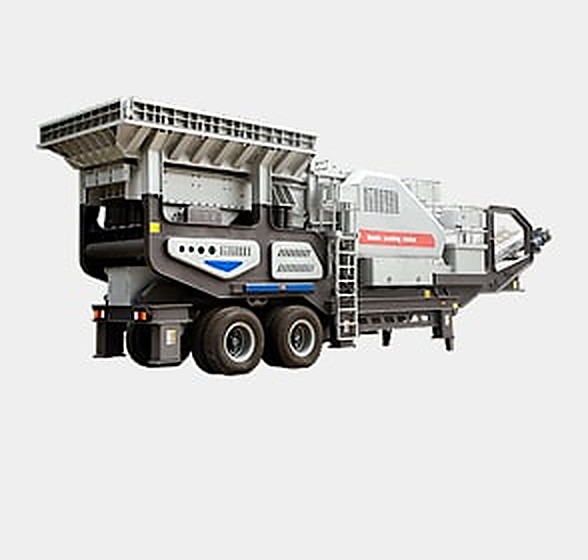
Mobile crushing and screening plant working at a quarry face — HAMAC equipment supplied to concrete and aggregate projects worldwide.
Recycling construction and demolition waste
Recycled concrete is abrasive and contains reinforcement, which changes the plant design. A magnetic separator over the discharge conveyor removes steel, and an impact crusher tolerates the mixed feed better than a cone. Dust and noise control are more demanding because recycling sites are often close to urban areas.
The product is usually used as sub-base or low-grade aggregate. Producing a higher-grade recycled aggregate requires tighter screening and, in many markets, additional testing to satisfy specification.
Defining the crushing duty before choosing equipment
The starting point is the material, not the machine. Rock type, blast size, moisture, clay content and the required product sizes decide the crusher type, the number of stages and the screen configuration. A plant designed for hard abrasive granite behaves very differently on soft limestone.
Throughput should be stated as finished product per hour, not feed per hour. A 200 t/h feed with a 30 percent reduction to fines and oversize produces considerably less saleable aggregate, and the difference decides whether the plant meets its contract.
Material
Abrasion
Typical primary
Typical secondary
Granite, basalt
High
Jaw crusher
Cone crusher
Limestone
Low to medium
Jaw or impact crusher
Impact crusher
River gravel
Medium
Jaw crusher
Cone crusher
Construction waste
Medium
Jaw crusher
Impact crusher
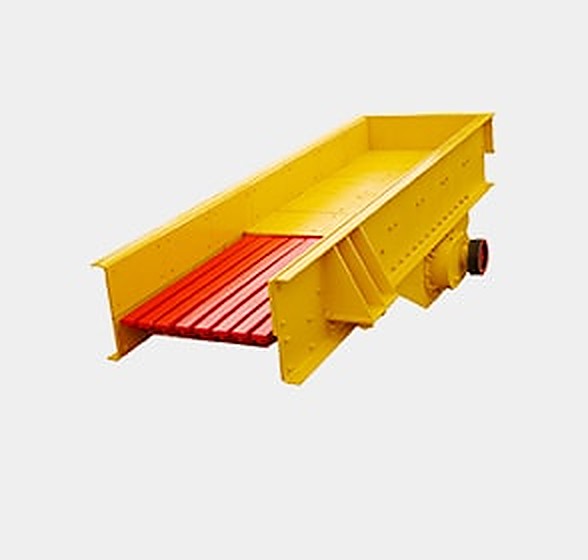
Vibrating feeder discharging run of quarry rock into a crusher — HAMAC equipment supplied to concrete and aggregate projects worldwide.
Jaw crusher as the primary stage
A jaw crusher reduces large feed to a size a secondary crusher can accept. Its advantages are a large feed opening, tolerance of clay and slabby rock, and simple maintenance. The trade-off is a flaky product shape and a capacity that drops sharply when the feed is wet and sticky.
The closed side setting controls the product size but also the capacity. Reducing the setting to produce a finer product increases the number of passes and the wear on the plates. For most quarry plants the primary setting is chosen to feed the secondary stage efficiently rather than to make a saleable product directly.
Cone crusher for hard rock and shape
A cone crusher produces a cubical product at high reduction ratios and tolerates hard abrasive rock better than an impact crusher. Cavity selection matters more than headline power: a coarse cavity handles a larger feed but produces a flatter shape, while a medium or fine cavity improves shape at lower throughput.
Cone crushers are usually operated in closed circuit with a screen, returning oversize to the crusher. This is what allows a plant to hold a tight product specification without excessive fines generation. The circulating load is a normal part of the process, not a sign of a problem.
Impact crusher for shape and soft rock
An impact crusher uses velocity rather than compression, which produces a well-shaped product with a high proportion of fractured faces. It is the preferred choice for limestone, dolomite and recycling, where the material is not highly abrasive.
Wear cost is the deciding factor. Blow bars in abrasive rock wear quickly, and the cost per tonne can be several times higher than a cone crusher on the same duty. On the right material, however, the shape advantage often justifies the wear cost because it reduces cement demand in concrete.
Where to go next
For the equipment side, see crushing and screening plants; for plant-level design and layout questions, see aggregate production solutions. If the project is in Tanzania or a comparable market, the HAMAC team can provide reference installations and a configuration proposal against your daily output target.
If you are comparing configurations, share the requirement with HAMAC and ask for a like-for-like quotation with the included scope listed item by item.
Need help applying this to your project?
Send your material type, target output and site conditions to HAMAC engineers. You will receive a practical equipment configuration and a clear quotation, normally within one working day.
Questions about this topic
Why is my cone crusher producing flaky aggregate?
The cavity is probably too coarse for the product size, or the feed is poorly graded. A finer cavity and a closed circuit with a screen usually correct the shape.
What is the wear life of jaw plates?
On abrasive granite, jaw plates typically last 300 to 800 operating hours depending on feed size and setting. Limestone can give several times that life.
How do I reduce fines in my product?
Reduce the reduction ratio per stage, use a cavity matched to the feed, and avoid over-crushing in closed circuit. Screening before the crusher also removes material that does not need crushing.
H
HAMAC Machinery Editorial Team
Written and reviewed by engineers and sales specialists who configure concrete batching plants, crushers, mixers and pumps for projects in more than 180 countries. Content is based on factory testing data and field feedback from delivered equipment.





 Company News

