For plant owners, the useful part of a trend report is the equipment implication. This article works from the data towards that conclusion.
Decarbonisation at the equipment level
Most of the carbon in concrete comes from cement, not from the plant. Equipment can still make a measurable difference: accurate batching avoids over-cementing, moisture compensation reduces water and cement variation, and efficient mixers shorten cycle time per cubic metre.
Electrification of plant drives and the use of variable-frequency controls reduce electricity consumption, and solar-ready control cabins are appearing on new installations in sunny markets. These measures are incremental, but they are also the ones a plant owner can act on without changing the mix design.
Automation and data in batching plants
Automation has moved from sequence control to data. A modern plant records every batch, every weighing and every deviation, and can send that record to a customer or a quality system. That traceability is increasingly a condition of supplying major projects.
The practical benefit for the owner is diagnostic. When a batch is rejected, the record shows whether the cause was material, weighing, mixing or delivery. Without the record the cause is a matter of opinion.
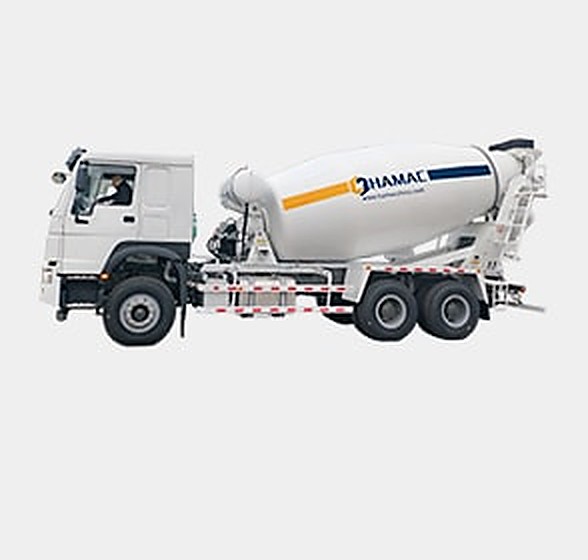
Concrete mixer truck discharging ready-mix concrete — HAMAC equipment supplied to concrete and aggregate projects worldwide.
Manufactured sand and aggregate supply
River sand is restricted or unavailable in many markets, and manufactured sand has become the default fine aggregate for concrete. The change affects the batching plant as much as the crusher: finer material, higher water demand and more variation between deliveries.
Plants that handle manufactured sand well share three features: covered storage, moisture measurement and a mix design that accounts for the filler content. These are inexpensive compared with the cost of rejected concrete.
Precast and modular construction
Modular and precast construction moves work from the site into a yard, which changes the equipment requirement from mobile placing to fixed production. Precast yards need accurate batching, consistent mixing and curing capacity rather than high-output pumping.
This shift favours suppliers who can provide a complete production line rather than individual machines, because the yard’s output is decided by the weakest stage in the sequence.
Stationary concrete batching plant with aggregate bins and cement silos — HAMAC equipment supplied to concrete and aggregate projects worldwide.
Total cost of ownership over ten years
Purchase price is typically 25 to 35 percent of the ten-year cost of a batching plant. Energy, labour, maintenance, wear parts and downtime make up the remainder. A plant that costs 15 percent more at purchase and 20 percent less to run is the cheaper machine.
Downtime is the hardest item to quantify and often the largest. One day of lost production on a 60 m3/h plant can exceed the annual saving from choosing a cheaper component supplier.
Cost element
Typical share of 10-year cost
Purchase and installation
25 - 35%
Energy
15 - 20%
Labour
15 - 20%
Maintenance and wear parts
10 - 15%
Downtime and lost output
10 - 20%
Equipment in extreme climates
Heat, cold, dust and humidity each change the specification. In desert conditions the priorities are cooling capacity, air filtration and electrical enclosure protection. In cold climates they are heating, insulation and low-temperature lubricants and steels.
Coastal and tropical sites add corrosion to the list. A paint system and a galvanising specification chosen for a temperate inland site will fail within a few years on a coastal site, and the repair cost exceeds the original saving.
The infrastructure pipeline and equipment demand
Large infrastructure programmes create demand in waves. Earthworks and crushing come first, then concrete production for structures, then paving and finishing. Equipment suppliers who understand the sequence can plan production and stock accordingly.
For buyers, the same sequence is a warning about timing. Ordering a batching plant when the programme reaches the concrete phase often means joining a queue, and lead times extend exactly when the project needs the plant most.
Where to go next
For the equipment side, see equipment solutions; for plant-level design and layout questions, see global project references. If the project is in Colombia or a comparable market, the HAMAC team can provide reference installations and a configuration proposal against your daily output target.
Send the daily volume, mix types and site conditions to HAMAC engineers and you will receive a configuration and a quotation, normally within one working day.
Need help applying this to your project?
Send your material type, target output and site conditions to HAMAC engineers. You will receive a practical equipment configuration and a clear quotation, normally within one working day.
Questions about this topic
What is the payback on a new batching plant?
It depends on utilisation and local concrete price. A plant running at high utilisation typically pays back in three to six years.
Which markets are growing fastest for concrete equipment?
Markets with rising infrastructure spending and a still-developing ready-mix sector, particularly in parts of Africa, South and Southeast Asia and the Middle East.
How does automation affect operating cost?
Automation reduces labour per cubic metre and produces batch records that reduce rejected loads. The larger benefit is traceability for quality schemes.
H
HAMAC Machinery Editorial Team
Written and reviewed by engineers and sales specialists who configure concrete batching plants, crushers, mixers and pumps for projects in more than 180 countries. Content is based on factory testing data and field feedback from delivered equipment.





 Company News

