The difference between an adequate installation and a good one is usually in the preparation. This guide covers a concrete pump for a ready-mix supplier serving a port expansion, with crushed granite as the reference material. The reference case is a 60 m3/h operation in Malaysia.
The operating context matters as much as the machine specification. In Malaysia, a ready-mix supplier serving a port expansion works in a tropical equatorial climate with high humidity. A plant specified for this market normally includes full corrosion protection and sealed electrical equipment, and the layout is planned around crushed granite rather than a generic aggregate.
Vertical pumping and pressure loss
Vertical delivery adds roughly 0.25 bar per metre of height for normal concrete, before friction losses in the pipe are counted. At 100 metres the static component alone is around 25 bar, which leaves little margin on a low-pressure pump and explains why high-rise work needs a pump with a high-pressure mode.
Friction depends on pipe diameter, mix design and pumping speed. A 125 mm line carrying a low-slump mix over 200 metres can require more pressure than a 150 mm line over the same distance. When a pump struggles, increasing pipe diameter is often more effective than increasing engine power.
Mix design for pumpability
A pumpable mix has enough fines and paste to lubricate the pipe wall, a controlled maximum aggregate size and a slump that stays workable for the duration of the pour. Gap-graded mixes and mixes with angular crushed sand are the most common causes of high pumping pressure.
Adding water to make concrete pump more easily is the wrong correction. It reduces the paste quality and causes segregation and bleeding at the discharge point. Adjusting the sand-to-total-aggregate ratio or adding a small dose of a pumping aid addresses the cause instead of the symptom.
Pouring task
Pressure requirement
Typical pump type
Low-rise, under 30 m horizontal
Low to medium
Trailer pump, 40 - 60 m3/h
High-rise, 60 - 150 m vertical
High
Trailer pump with high-pressure mode
Wide site, 200 m horizontal
Medium, long line
Trailer or line pump, 60 - 80 m3/h
Fast deck pours, 100 m3/h and above
Medium
Truck-mounted boom pump
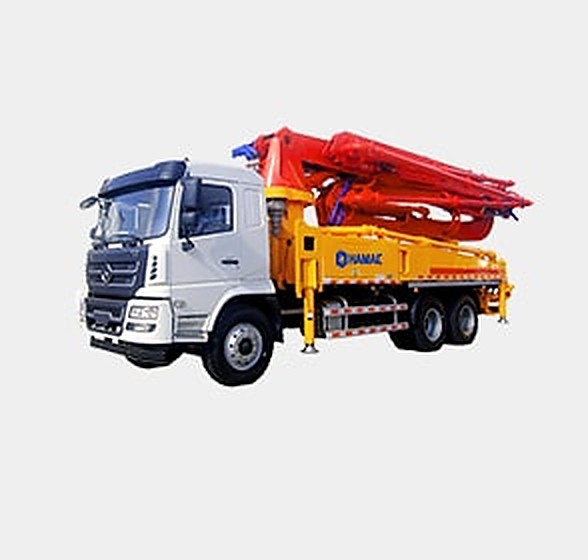
Truck mounted concrete boom pump placing concrete on a building site — HAMAC equipment supplied to concrete and aggregate projects worldwide.
Clearing a blocked line safely
The first step is to stop pumping, reverse the pump briefly at low pressure and listen for movement. If the line remains blocked, depressurize fully before opening any joint. A pressurized line holds enough energy to injure an operator seriously, and this is the single most important safety rule on a pumping site.
Locate the blockage by tapping along the pipe; a dull sound indicates full pipe, a hollow sound the blockage. Once identified, close the isolating valve, relieve pressure and open only the section concerned. Never stand in front of an open coupling while pressure remains in the line.
Wear parts and their service life
The wear items are the delivery piston, the S-valve or seat, the wear ring and the pipe itself, particularly at bends. Service life depends on the abrasiveness of the aggregate and on pumping pressure. Crushed granite at high pressure can wear an S-valve in a few thousand cubic metres, while rounded river gravel can last several times longer.
Inspect the S-valve and wear ring every 500 to 1000 cubic metres, and measure rather than judge by appearance. A worn valve seat shows up first as a loss of pressure at the end of the stroke and a pulsing delivery, long before it fails completely.
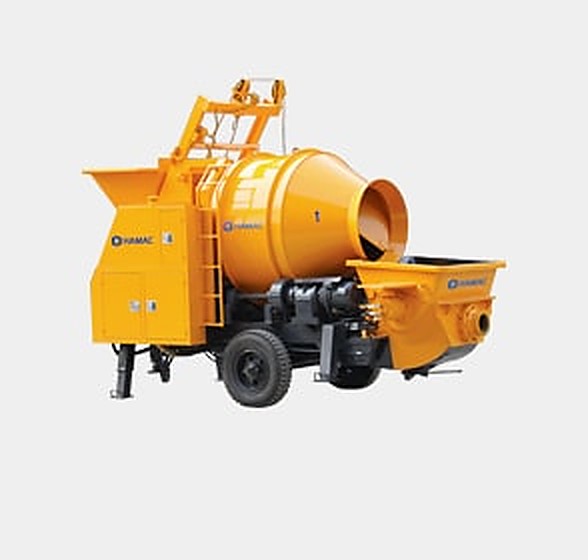
Trailer concrete mixer pump combining mixing and pumping — HAMAC equipment supplied to concrete and aggregate projects worldwide.
Boom pump stability and outrigger practice
A boom pump transfers large overturning moments to the ground through its outriggers. Ground bearing capacity, not the machine, is usually the limiting factor. On fill, recent excavation or a basement slab of unknown thickness, spreader plates or timber mats are required, and the outriggers must be fully extended.
Boom operation should follow the manufacturer load chart. Slewing with a full pipeline of concrete at maximum reach produces the highest moment, and wind adds an additional load that is easy to underestimate on a tall boom. A trained operator and a banksman at the discharge point are not optional.
Placing booms for high-rise work
A placing boom mounted on the building frame distributes concrete across a floor without a truck-mounted boom. A self-climbing boom rises with the structure, while a fixed boom is dismantled and re-erected at intervals. The choice depends on the number of floors and the crane capacity available.
Installation requires a structural connection designed by the building engineer, not by the equipment supplier alone. The reaction forces at the base and the temporary loads during climbing must be checked against the slab and column design.
Output calculation for planning
The volume a pump places in an hour is the product of the stroke volume, the number of strokes and the volumetric efficiency. In practice, planning uses 60 to 75 percent of the theoretical figure for a well-managed pour, with lower values for high-pressure or long-line work.
The real constraint is often the supply of concrete, not the pump. A pump rated at 60 m3/h cannot place more than the batching plant and trucks can deliver. Matching pump capacity to supply protects the pump from running dry and keeps the pour continuous.
Where to go next
For the equipment side, see concrete pumping equipment; for plant-level design and layout questions, see concrete pumping solutions. If the project is in Malaysia or a comparable market, the HAMAC team can provide reference installations and a configuration proposal against your daily output target.
Send the daily volume, mix types and site conditions to HAMAC engineers and you will receive a configuration and a quotation, normally within one working day.
Need help applying this to your project?
Send your material type, target output and site conditions to HAMAC engineers. You will receive a practical equipment configuration and a clear quotation, normally within one working day.
Questions about this topic
Is a mixer pump suitable for structural concrete?
Yes, when the mixer is a twin-shaft type with proper weighing. Output is limited by the mixing cycle, so it suits small to medium pours rather than high-volume supply.
How do I choose between diesel and electric drive?
Choose electric where the site has a stable supply and the pour is long, because the running cost per cubic metre is lower. Choose diesel where power is unreliable or the machine moves frequently.
What pressure is needed to pump 100 metres vertically?
Vertical height alone adds about 25 bar at 100 metres, before friction. Plan for a pump that can deliver at least 60 to 80 bar at the working output to keep a margin.
H
HAMAC Machinery Editorial Team
Written and reviewed by engineers and sales specialists who configure concrete batching plants, crushers, mixers and pumps for projects in more than 180 countries. Content is based on factory testing data and field feedback from delivered equipment.





 Company News

