For a concrete mixer handling a contractor with mixed building and infrastructure work, the practical questions are rarely about a single specification figure. This article works through crushed basalt and the site conditions that change the answer. The reference case is a 75 m3/h operation in Turkey.
The operating context matters as much as the machine specification. In Turkey, a contractor with mixed building and infrastructure work works in a mixed climate with cold winters and hot, dry summers. A plant specified for this market normally includes a dual specification covering frost protection and summer cooling, and the layout is planned around crushed basalt rather than a generic aggregate.
Precast concrete mixing requirements
Precast production needs a mix that releases from the mould cleanly, reaches early strength for demoulding and repeats exactly from one casting to the next. That requires accurate batching, short and consistent mixing cycles and a mixer that does not leave material on the pan walls.
Because the same mix is used thousands of times, small variations matter. A 1 percent error in water content that would be invisible on a structural pour can produce visible surface defects across a production run.
What mixing actually has to achieve
Mixing distributes cement, water, aggregates and admixtures so that every sample taken from the batch has the same composition. The target is uniformity, not simply movement. A mixer that turns the material quickly but leaves dead zones at the ends of the trough will produce batches that vary from one discharge to the next.
Mixing time and mixing action together determine uniformity. Standards such as EN 206 set limits on the variation of strength and cement content between samples from the same batch, and those limits are what a mixer has to meet in practice.
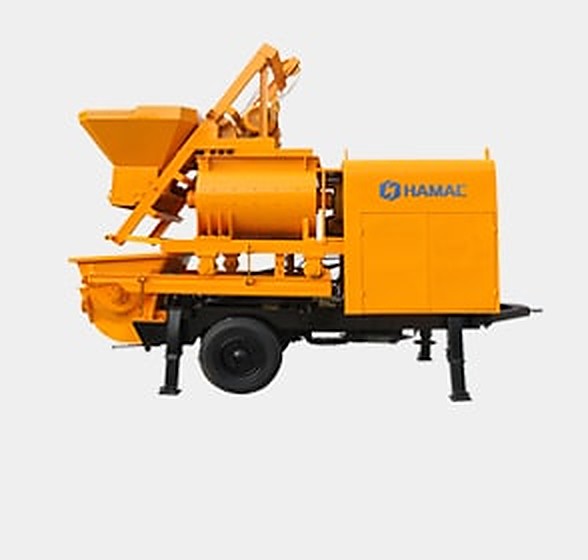
Concrete mixer pump with twin shaft mixer and piston pump — HAMAC equipment supplied to concrete and aggregate projects worldwide.
Twin-shaft versus planetary action
A twin-shaft mixer uses two counter-rotating shafts with inclined blades that lift material from the centre and push it towards the ends, creating a circulating flow. It mixes quickly and handles stiff, low-slump concrete without stalling, which is why it dominates ready-mix production.
A planetary mixer uses arms that rotate around their own axes while the whole assembly travels around the pan. The result is a more intense kneading action with no dead zones, which suits high-strength, self-compacting and fibre-reinforced mixes. Cycle time is longer and the machine is more expensive.
Criterion
Twin-shaft
Planetary
Mix cycle
30 - 45 seconds
45 - 90 seconds
Best suited to
Commercial and structural concrete
Precast, UHPC, SCC, fibre mixes
Wear part cost
Moderate
Higher
Batch size flexibility
Good
Very good at small batches
Matching mixer size to plant output
The mixer is the bottleneck in most batching plants. Output per hour is the batch volume multiplied by the number of complete cycles, and the cycle includes charging, mixing and discharge. A 2 m3 mixer with a 60 second total cycle delivers about 120 m3/h in theory and 85 to 95 m3/h in practice.
Increasing mixer volume is usually cheaper than reducing cycle time. Shortening mixing below the value required for uniformity produces rejected concrete, which costs far more than the extra capacity would have cost.
Twin shaft compulsory concrete mixer used in batching plants — HAMAC equipment supplied to concrete and aggregate projects worldwide.
Drum mixers and their place
A drum mixer relies on tumbling action inside a rotating drum. It is simple, robust and inexpensive, and it works well for plastic mixes with a high slump. It is less effective on stiff or high-strength mixes and it cannot match the uniformity of a compulsory mixer.
Drum mixers are common on small sites, in self-loading mixer trucks and in mobile plants where simplicity matters more than mixing quality. For structural concrete supplied to a specification, a compulsory mixer is normally required.
Charging sequence and its effect on quality
The order in which materials enter the mixer affects both mixing time and the risk of balling. A common sequence is coarse aggregate, then cement and fines, then water with admixture, with the last part of the water added after the dry materials are wetted. This prevents cement from coating the blades and forming lumps.
Admixtures should never be added directly onto dry cement. Diluting the admixture in part of the mixing water and adding it late in the cycle gives a more predictable result and avoids the flash setting that occurs when a concentrated dose contacts cement.
Wear parts and their inspection
Mixer blades, arms, liners and the shaft seal are the parts that wear. Blade clearance to the liner is the critical measurement: as blades wear, a layer of mortar remains on the pan floor and the effective mixing action drops. Measuring clearance monthly and adjusting or replacing blades restores performance at low cost.
The shaft seal is the part most often neglected. A leaking seal lets cement paste into the bearing, and the resulting failure is expensive. Greasing the seal on the recommended schedule is a small task that prevents a major repair.
Where to go next
For the equipment side, see concrete mixers and batching plants; for plant-level design and layout questions, see on-site mixing and pumping. If the project is in Turkey or a comparable market, the HAMAC team can provide reference installations and a configuration proposal against your daily output target.
If you are comparing configurations, share the requirement with HAMAC and ask for a like-for-like quotation with the included scope listed item by item.
Need help applying this to your project?
Send your material type, target output and site conditions to HAMAC engineers. You will receive a practical equipment configuration and a clear quotation, normally within one working day.
Questions about this topic
Twin shaft or planetary mixer?
Twin shaft for commercial and structural concrete at high output; planetary for precast, self-compacting and fibre mixes where mixing intensity matters more than cycle time.
Why does concrete stick to the mixer?
Usually too much water added at the start, cement added onto dry blades, or worn blades that no longer sweep the liner. Check the charging sequence first.
How full should a mixer be?
Never above the rated batch volume. Overfilling spills material, overloads the drive and prevents the mixing action from developing properly.
H
HAMAC Machinery Editorial Team
Written and reviewed by engineers and sales specialists who configure concrete batching plants, crushers, mixers and pumps for projects in more than 180 countries. Content is based on factory testing data and field feedback from delivered equipment.






 Company News
