Most problems with a concrete batching plant appear months after installation, not on the first day. This guide explains a regional ready-mix producer and how river gravel and manufactured sand can avoid the common failures. The reference case is a 50 m3/h operation in Philippines.
The operating context matters as much as the machine specification. In Philippines, a regional ready-mix producer works in a tropical climate with heavy rainfall and high humidity. A plant specified for this market normally includes corrosion protection, covered storage and reliable drainage around the plant, and the layout is planned around river gravel and manufactured sand rather than a generic aggregate.
Matching plant capacity to real daily demand
Capacity is usually quoted as theoretical output per hour, measured with a fully charged batching machine and a continuous supply of aggregates. Real output is lower because batching, charging, mixing and discharge overlap with truck changes and quality checks. A reliable planning figure is 75 to 85 percent of the rated value for a well-run plant.
Start from the concrete volume required on the busiest day rather than the average day. Divide that volume by the productive hours in a shift, then add headroom for peaks. A plant sized exactly to average demand will queue trucks whenever a large pour is scheduled.
Rated output
Typical realistic output
Usual application
HZS25 - 35 m3/h
20 - 28 m3/h
Small contractor, single site
HZS50 - 60 m3/h
40 - 50 m3/h
Commercial supply, small town
HZS75 - 90 m3/h
60 - 75 m3/h
Ready-mix supplier, mid-size city
HZS120 - 180 m3/h
95 - 145 m3/h
High-volume ready-mix, major projects
Stationary versus mobile configuration
A stationary plant is built on a concrete foundation with a fixed aggregate storage area. It offers the lowest cost per cubic metre over a long project, better access for wheel loaders and more room for silos and automation. It is the default choice when the site will operate for more than two years.
A mobile or portable plant sits on a steel frame with its own axle or skid. Setup takes days rather than weeks and the whole unit can be relocated behind a low-bed trailer. Output per hour is lower and aggregate storage is usually limited to a few compartments, but for road, rail and dam projects that move every season it removes the cost of repeated civil works.
Fixed site with more than two years of production: stationary plant
Project moving every 6 to 18 months: mobile or portable plant
Site with limited space and no room for a loader yard: compact mobile unit
Requirement for multiple silos and full automation: stationary plant
Twin shaft compulsory concrete mixer used in batching plants — HAMAC equipment supplied to concrete and aggregate projects worldwide.
Layout rules that protect output
The layout decides how quickly a truck can be loaded and how easily a wheel loader can feed the aggregate bins. The most common mistake is placing the batching machine so that the loader has to reverse into the charging area, which adds 20 to 40 seconds to every batch cycle and increases the risk of contact with the plant structure.
Keep the truck lane straight and level, with a clear exit that does not cross the loader route. Allow a minimum turning radius for the largest mixer truck in the fleet, and leave space for a second truck to wait without blocking the discharge area. The control cabin should have a direct line of sight to the discharge point and to the aggregate bins.
Aggregate storage and feeding
Aggregate bins are sized by the number of fractions the mix design requires, not by the total volume of the yard. Four compartments cover most structural concrete; five or six are needed when a plant produces both structural and pavement mixes or uses manufactured sand alongside natural sand.
Partition walls must be high enough to prevent overflow between compartments, and the discharge gates should be accessible for clearing blockages. In wet climates a covered storage area keeps moisture content stable, which matters because batching is done by weight and a variable moisture content forces the operator to adjust water continuously.
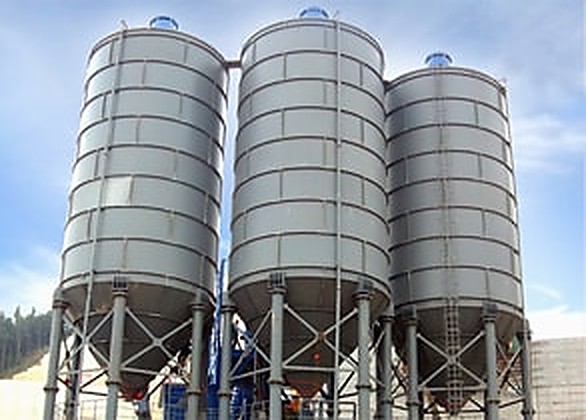
Welded cement silo with screw conveyor and pressure relief valve — HAMAC equipment supplied to concrete and aggregate projects worldwide.
Cement and fly ash silo sizing
Silo capacity is a function of delivery rhythm, not of plant output. A 100 tonne silo gives roughly one day of production for a 60 m3/h plant using 300 kg of cement per cubic metre. If the nearest cement supplier is two hours away, two silos or a larger single silo avoids stoppages caused by late deliveries.
When the mix design includes fly ash or slag, each binder needs its own silo and screw conveyor. Sharing a silo between two binders is not practical because residual material contaminates the next batch. Silo accessories such as pressure relief valves, level indicators and aeration pads are not optional extras; they are what keeps discharge consistent.
Weighing accuracy and batching tolerance
Commercial concrete is normally batched to within plus or minus one percent for cement and water and plus or minus two percent for aggregates. Achieving that tolerance depends on load cell quality, the rigidity of the weighing frame and the way the discharge gates close. A gate that closes slowly delivers an extra few kilograms on every batch.
Calibration should be carried out with test weights, not by entering an assumed value in the control system. Repeat the check after the first week of production, because settlement of the frame and vibration during operation can shift the zero point. Records of calibration are also part of most quality audits.
Mixer selection inside the plant
The twin-shaft compulsory mixer is the standard for commercial concrete because it completes a homogeneous mix in 30 to 45 seconds and handles low-slump and high-strength mixes without dead zones. Planetary mixers are chosen for precast, ultra-high-performance concrete and mixes with very fine additions, where the counter-current motion produces a faster and more uniform dispersion.
Mixer size must match the batching machine. A plant with a 2.0 m3 output mixer cannot sustain the rated output of a batching machine sized for 3.0 m3 batches. When output is the priority, it is cheaper to increase mixer volume than to shorten mixing time below the value required for uniformity.
Where to go next
For the equipment side, see concrete batching plants; for plant-level design and layout questions, see concrete production solutions. If the project is in Philippines or a comparable market, the HAMAC team can provide reference installations and a configuration proposal against your daily output target.
Send the daily volume, mix types and site conditions to HAMAC engineers and you will receive a configuration and a quotation, normally within one working day.
Need help applying this to your project?
Send your material type, target output and site conditions to HAMAC engineers. You will receive a practical equipment configuration and a clear quotation, normally within one working day.
Questions about this topic
How accurate is batching on a standard plant?
Cement and water are normally within plus or minus one percent and aggregates within plus or minus two percent, provided the load cells are calibrated with test weights and the discharge gates close cleanly.
How long does installation take?
A 60 to 90 m3/h stationary plant normally takes 10 to 20 days with a competent local team, excluding foundation curing. Mobile plants can be producing within three to five days.
Can a batching plant produce different concrete grades?
Yes. Recipes are stored in the control system and selected per truck. Changeover time depends on whether the aggregate fractions and binder type are the same.
H
HAMAC Machinery Editorial Team
Written and reviewed by engineers and sales specialists who configure concrete batching plants, crushers, mixers and pumps for projects in more than 180 countries. Content is based on factory testing data and field feedback from delivered equipment.






 Company News
