Specification sheets describe a machine, not a working installation. This article looks at a concrete pump in the context of a regional ready-mix producer and river gravel and manufactured sand, and at the details that decide whether it performs as expected. The reference case is a 50 m3/h operation in Philippines.
The operating context matters as much as the machine specification. In Philippines, a regional ready-mix producer works in a tropical climate with heavy rainfall and high humidity. A plant specified for this market normally includes corrosion protection, covered storage and reliable drainage around the plant, and the layout is planned around river gravel and manufactured sand rather than a generic aggregate.
Output calculation for planning
The volume a pump places in an hour is the product of the stroke volume, the number of strokes and the volumetric efficiency. In practice, planning uses 60 to 75 percent of the theoretical figure for a well-managed pour, with lower values for high-pressure or long-line work.
The real constraint is often the supply of concrete, not the pump. A pump rated at 60 m3/h cannot place more than the batching plant and trucks can deliver. Matching pump capacity to supply protects the pump from running dry and keeps the pour continuous.
Diesel or electric drive
A diesel pump is independent of site power and can be moved between locations without an electrical supply. Fuel cost and engine maintenance are the ongoing expense, and noise and exhaust limit its use in enclosed or residential areas.
An electric pump has lower running cost per cubic metre and is quieter, which suits long-duration pours on sites with a reliable supply. The installation needs a properly sized supply cable and protection, and a power failure in the middle of a pour is a serious risk that requires a standby plan.
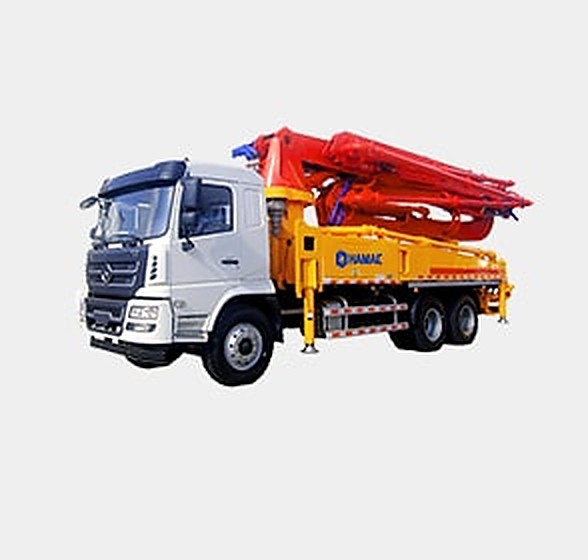
Truck mounted concrete boom pump placing concrete on a building site — HAMAC equipment supplied to concrete and aggregate projects worldwide.
Daily and long-term maintenance
After every pour, the hopper, S-valve and pipeline must be cleaned before the concrete sets. The water box and piston seals need checking, and the hydraulic oil level and cooler should be inspected. Greasing points on the boom and the outriggers are easy to neglect and expensive to repair.
Long-term maintenance centres on hydraulic oil condition, piston and seal replacement and structural inspection of the boom. Oil analysis at fixed intervals is a cheap way to detect contamination before it damages the pump and the valves.
Selecting a pump for a rental fleet
A rental pump has to suit many customers rather than one project. Medium output with high pressure covers the widest range of work, and a robust pipeline set with spare bends reduces downtime. Machines with common parts across the fleet simplify stock and operator training.
Rental economics depend on utilisation and turnaround. A pump that can be cleaned and dispatched in two hours earns more than a slightly cheaper machine that needs a full day between jobs.
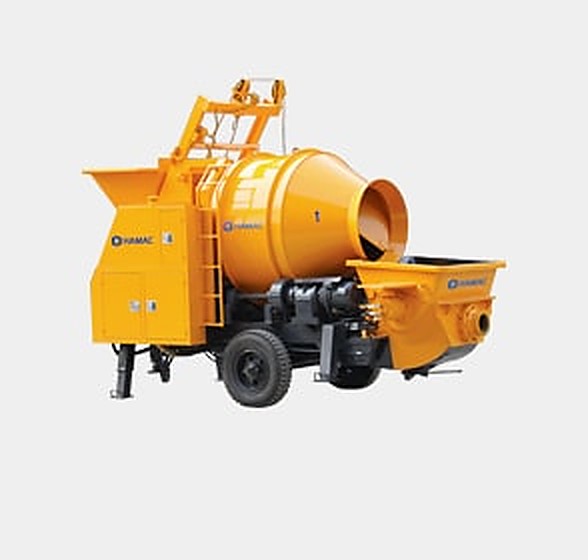
Trailer concrete mixer pump combining mixing and pumping — HAMAC equipment supplied to concrete and aggregate projects worldwide.
Reading a concrete pump specification correctly
A pump is specified by theoretical output, delivery pressure, delivery distance and power. The output quoted in brochures is measured with water and no pipeline. With a real mix, output falls as pressure rises, and the practical limit is reached when the pressure required to move the concrete exceeds what the pump can generate.
The useful comparison is the combination of pressure and output at the working point. A pump with high output but modest pressure will move large volumes at short distance; a pump with high pressure and lower output will reach further vertically or horizontally. Neither is better until the pour is defined.
Pouring task
Pressure requirement
Typical pump type
Low-rise, under 30 m horizontal
Low to medium
Trailer pump, 40 - 60 m3/h
High-rise, 60 - 150 m vertical
High
Trailer pump with high-pressure mode
Wide site, 200 m horizontal
Medium, long line
Trailer or line pump, 60 - 80 m3/h
Fast deck pours, 100 m3/h and above
Medium
Truck-mounted boom pump
Trailer pump, line pump and boom pump
A trailer pump stays in one position and delivers through a pipeline. It is the most economical way to move concrete at volume, and it can be moved between sites behind a truck. A line pump is the same principle with a smaller hopper and pipeline, used where access is tight and output demand is moderate.
A truck-mounted boom pump carries its own placing boom and needs no pipeline for most pours. It moves between pours quickly and places concrete precisely, which is why it dominates building construction. The trade-off is a much higher purchase price and the need for a trained operator and outrigger space.
Mixer pump: one machine for mixing and placing
A concrete mixer pump combines a drum or twin-shaft mixer with a pump on a single chassis. It is used where concrete is mixed on site rather than delivered, typically on rural projects, small buildings and sites where ready-mix supply is unreliable or expensive.
Output is limited by the mixing cycle rather than the pump, so the practical figure is lower than the pump rating suggests. The advantage is that a single operator can produce and place concrete without a separate mixer, a wheelbarrow gang or a crane and skip.
Where to go next
For the equipment side, see concrete pumping equipment; for plant-level design and layout questions, see concrete pumping solutions. If the project is in Philippines or a comparable market, the HAMAC team can provide reference installations and a configuration proposal against your daily output target.
If you are comparing configurations, share the requirement with HAMAC and ask for a like-for-like quotation with the included scope listed item by item.
Need help applying this to your project?
Send your material type, target output and site conditions to HAMAC engineers. You will receive a practical equipment configuration and a clear quotation, normally within one working day.
Questions about this topic
How often should pump pipes be replaced?
Inspect the wall thickness of straight sections and bends every few thousand cubic metres. Bends wear several times faster than straight pipe and should be treated as consumables.
What causes a blockage at the first elbow?
Usually a dry or poorly lubricated start, a mix that is too stiff, or a short-radius bend. Prime the line with mortar and use long-radius bends in the first section.
How far can a concrete pump deliver horizontally?
A trailer pump with a high-pressure mode can reach 300 to 500 metres horizontally in favourable conditions. Beyond that, friction losses and mix design usually make a relay or a different placing method more practical.
H
HAMAC Machinery Editorial Team
Written and reviewed by engineers and sales specialists who configure concrete batching plants, crushers, mixers and pumps for projects in more than 180 countries. Content is based on factory testing data and field feedback from delivered equipment.





 Company News

