A plant that runs at its rated output for years is the result of a few correct decisions at the start. This article explains a concrete mixer and the choices that matter most for a contractor on a coastal road project using river gravel. The reference case is a 35 m3/h operation in Mozambique.
The operating context matters as much as the machine specification. In Mozambique, a contractor on a coastal road project works in a tropical coastal climate with a cyclone season. A plant specified for this market normally includes structural anchoring for wind loading and corrosion protection for salt air, and the layout is planned around river gravel rather than a generic aggregate.
Matching mixer size to plant output
The mixer is the bottleneck in most batching plants. Output per hour is the batch volume multiplied by the number of complete cycles, and the cycle includes charging, mixing and discharge. A 2 m3 mixer with a 60 second total cycle delivers about 120 m3/h in theory and 85 to 95 m3/h in practice.
Increasing mixer volume is usually cheaper than reducing cycle time. Shortening mixing below the value required for uniformity produces rejected concrete, which costs far more than the extra capacity would have cost.
Drum mixers and their place
A drum mixer relies on tumbling action inside a rotating drum. It is simple, robust and inexpensive, and it works well for plastic mixes with a high slump. It is less effective on stiff or high-strength mixes and it cannot match the uniformity of a compulsory mixer.
Drum mixers are common on small sites, in self-loading mixer trucks and in mobile plants where simplicity matters more than mixing quality. For structural concrete supplied to a specification, a compulsory mixer is normally required.
Criterion
Twin-shaft
Planetary
Mix cycle
30 - 45 seconds
45 - 90 seconds
Best suited to
Commercial and structural concrete
Precast, UHPC, SCC, fibre mixes
Wear part cost
Moderate
Higher
Batch size flexibility
Good
Very good at small batches
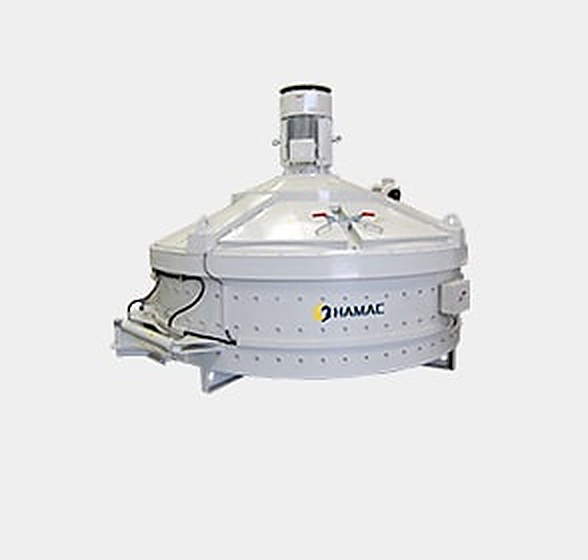
Planetary concrete mixer for high-strength and precast concrete — HAMAC equipment supplied to concrete and aggregate projects worldwide.
Charging sequence and its effect on quality
The order in which materials enter the mixer affects both mixing time and the risk of balling. A common sequence is coarse aggregate, then cement and fines, then water with admixture, with the last part of the water added after the dry materials are wetted. This prevents cement from coating the blades and forming lumps.
Admixtures should never be added directly onto dry cement. Diluting the admixture in part of the mixing water and adding it late in the cycle gives a more predictable result and avoids the flash setting that occurs when a concentrated dose contacts cement.
Wear parts and their inspection
Mixer blades, arms, liners and the shaft seal are the parts that wear. Blade clearance to the liner is the critical measurement: as blades wear, a layer of mortar remains on the pan floor and the effective mixing action drops. Measuring clearance monthly and adjusting or replacing blades restores performance at low cost.
The shaft seal is the part most often neglected. A leaking seal lets cement paste into the bearing, and the resulting failure is expensive. Greasing the seal on the recommended schedule is a small task that prevents a major repair.
Concrete mixer truck discharging ready-mix concrete — HAMAC equipment supplied to concrete and aggregate projects worldwide.
Self-loading mixer trucks
A self-loading mixer loads aggregates with its own shovel, weighs them, adds cement and water and mixes in transit. It removes the need for a batching plant and a wheel loader, which makes it suited to dispersed sites, rural work and small contracts where setting up a plant is not economic.
Output is limited by the loading cycle, typically 15 to 25 m3 per hour depending on the model and the operator. The advantage is that this output is available at the point of use, without a delivery fleet or a fixed plant.
Transport and slump control
Concrete loses slump during transport as cement hydrates and water is absorbed. Drum rotation keeps the mix alive but too much rotation at high speed adds heat and accelerates stiffening. The usual practice is a few revolutions per minute in transit and a faster mix before discharge.
Retempering with water on site is allowed only within the limits of the specification and only if the water-cement ratio is not exceeded. Adding water without accounting for it is the most common cause of low strength in delivered concrete.
Precast concrete mixing requirements
Precast production needs a mix that releases from the mould cleanly, reaches early strength for demoulding and repeats exactly from one casting to the next. That requires accurate batching, short and consistent mixing cycles and a mixer that does not leave material on the pan walls.
Because the same mix is used thousands of times, small variations matter. A 1 percent error in water content that would be invisible on a structural pour can produce visible surface defects across a production run.
Where to go next
For the equipment side, see concrete mixers and batching plants; for plant-level design and layout questions, see on-site mixing and pumping. If the project is in Mozambique or a comparable market, the HAMAC team can provide reference installations and a configuration proposal against your daily output target.
HAMAC can prepare a layout drawing and a budgetary quotation against your daily output target, including the civils information your contractor will need.
Need help applying this to your project?
Send your material type, target output and site conditions to HAMAC engineers. You will receive a practical equipment configuration and a clear quotation, normally within one working day.
Questions about this topic
How often should gearbox oil be changed?
Follow the manufacturer interval, typically 2,000 to 5,000 hours, and check the oil for water or metal particles at every change.
Twin shaft or planetary mixer?
Twin shaft for commercial and structural concrete at high output; planetary for precast, self-compacting and fibre mixes where mixing intensity matters more than cycle time.
Why does concrete stick to the mixer?
Usually too much water added at the start, cement added onto dry blades, or worn blades that no longer sweep the liner. Check the charging sequence first.
H
HAMAC Machinery Editorial Team
Written and reviewed by engineers and sales specialists who configure concrete batching plants, crushers, mixers and pumps for projects in more than 180 countries. Content is based on factory testing data and field feedback from delivered equipment.






 Company News

