




In this article
What is a concrete placing boom?
Concrete placing boom is the terminal equipment connected to the various concrete pumps (concrete line pump, trailer concrete pump etc) and then placing the concrete. It is an auxiliary equipment of concrete conveying pump. It is connected by standard 5 inches conveying piping, just like a manipulator can quickly and accurately reach any pouring part of the working surface and carry out continuous pouring, which is a better solution to the problem. The distribution problem of concrete conveying greatly reduces labor intensity and improves the progress and quality of construction.
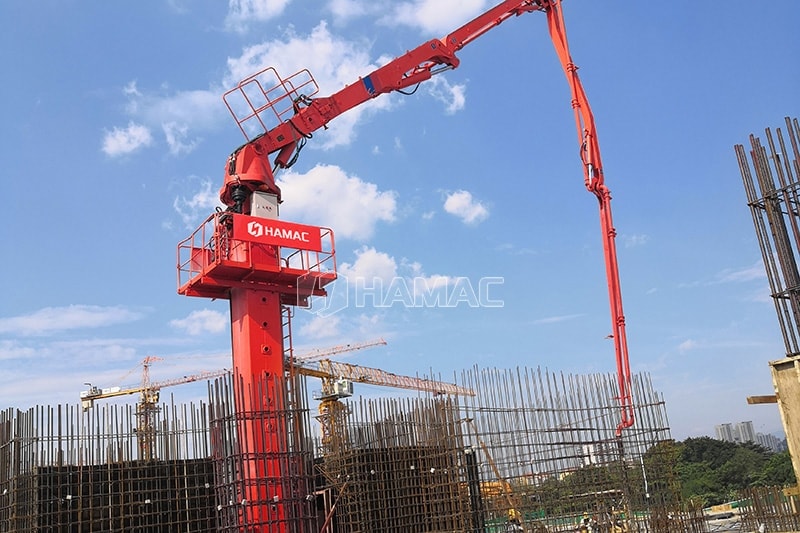
33m Self-climbing concrete placing boom
How many types concrete placing boom there are?
At present, there are many types of concrete placing boom on the market. Let's introduce the characteristics of the placing boom and its usefulness.
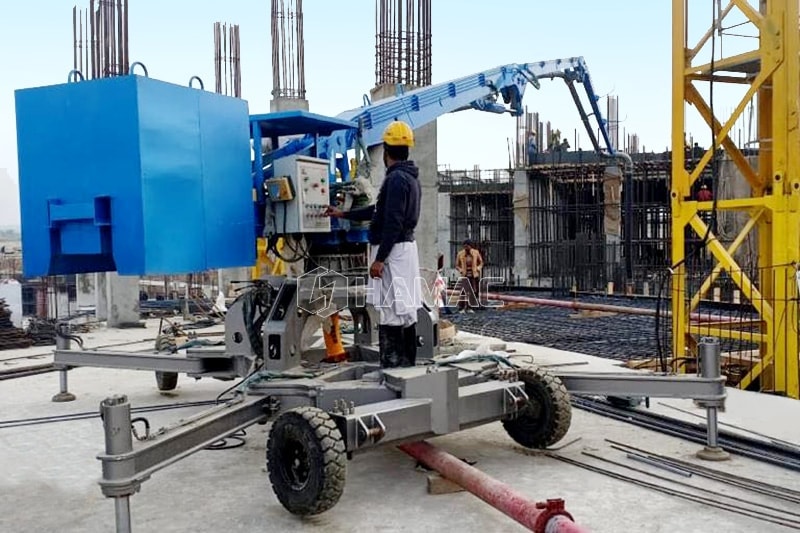
1. Manual placing boom machine, which is the most commonly used concrete placing machine at present. It is cheap, but the efficiency is very low. At least 4 workers are required to operate this machine, and the placing radius of the manual type is from 12 meters to 18 meters.
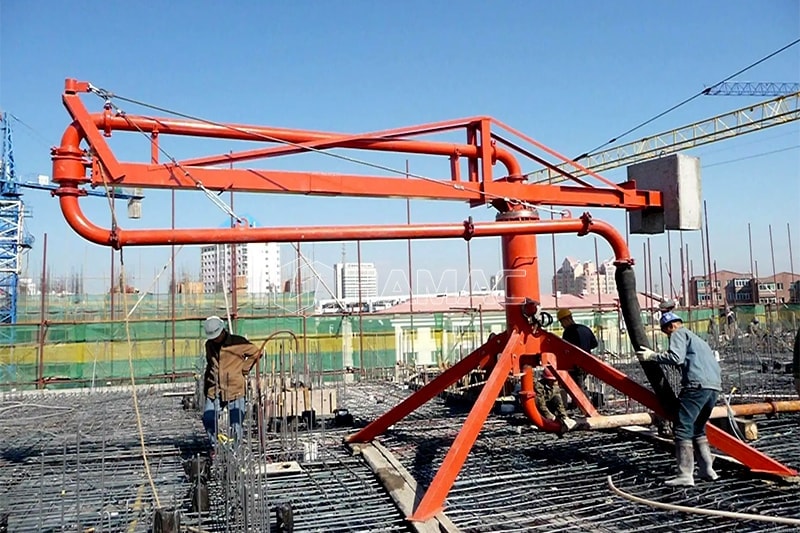
Manual concrete placing boom is working
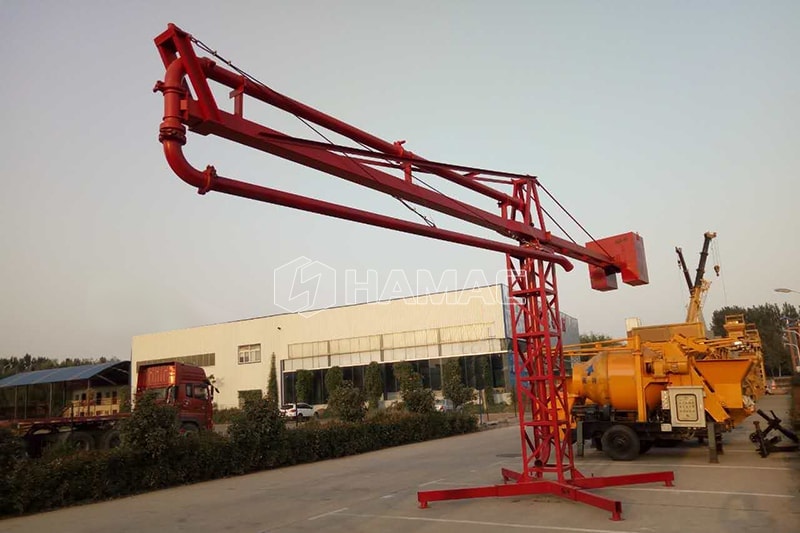
Manual concrete placing boom with support frame
2. Spider type placing boom, it is also named mobile concrete placing boom, its placing radius from 13-21m. We have HGY13, HGY15, HGY17, HGY21. It is fully hydraulic driven, its working efficiency is higher compared with the manual type. It can be lifted by the tower crane which is nearby the building. So, it can be moved in different positions on the floor.
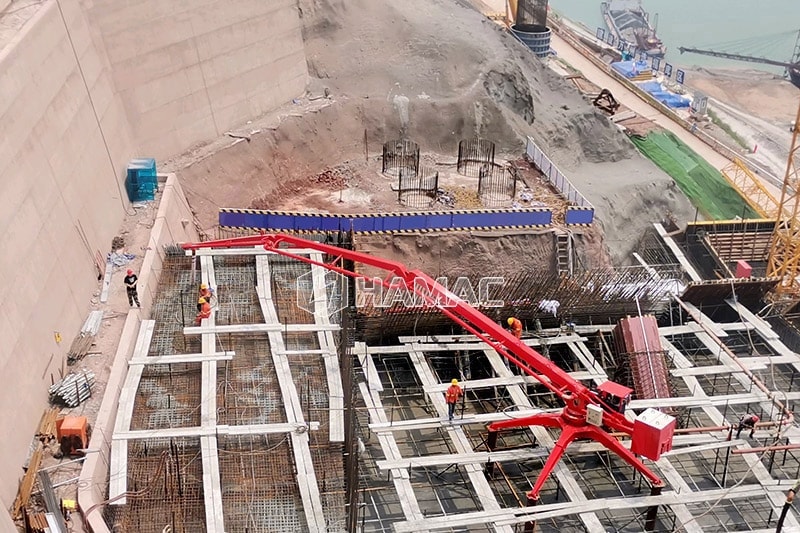
Bird view to see how does the placing boom work
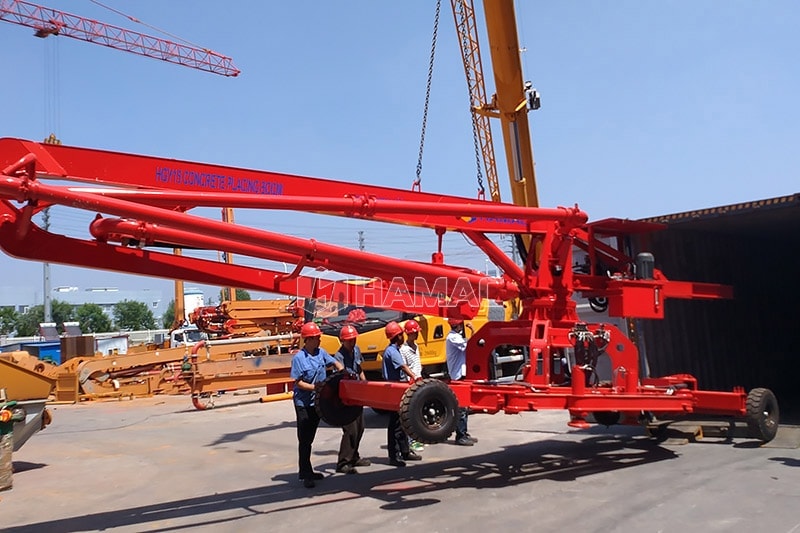
Mobile Concrete placing boom loaded into container
| Item | HGY13 | HGY15 | HGY17 | HGY21 |
| Max. Placing Radius (M) | 13 | 15 | 17 | 21 |
| Small Arm Elevation (°) | 0~180 | 0~180 | 0~180 | 0~180 |
| Hose Length (M) | 3 | 3 | 3 | 3 |
| Concrete Delivery Pipe (Mm) | Ø125×6 | Ø125×6 | Ø125×6 | Ø125×6 |
| Tail Rotary Radius (M) | 2.72 | 2.81 | 3.51 | 3.51 |
| Total Power (Kw) | 4 | 4 | 5.5/7.5 | 11 |
| Rotary Range (°) | 0~360 | 0~360 | 0~360 | 0~360 |
| Overall Height (M) | 2.9 | 2.6 | 3.2 | 3.2 |
| Bare Machine Weight (Kg) | 2700 | 3230 | 5000 | 10000 |
| Balance Weight (Kg) | 2×900 | 2×1100 | 2200 | 2×2500 |
| Control Mode | Panel/ Wireless Remote Control | Panel/ Wireless Remote Control | Panel/ Wireless Remote Control | Panel/ Wireless Remote Control |
3. Self-climbing concrete placing boom, its placing boom radius is bigger. Normally speaking, it is installed in the elevator shaft or in the building floors. It can rise by itself through the hydraulic climbing system. It is more suitable for the high building with big floor area.
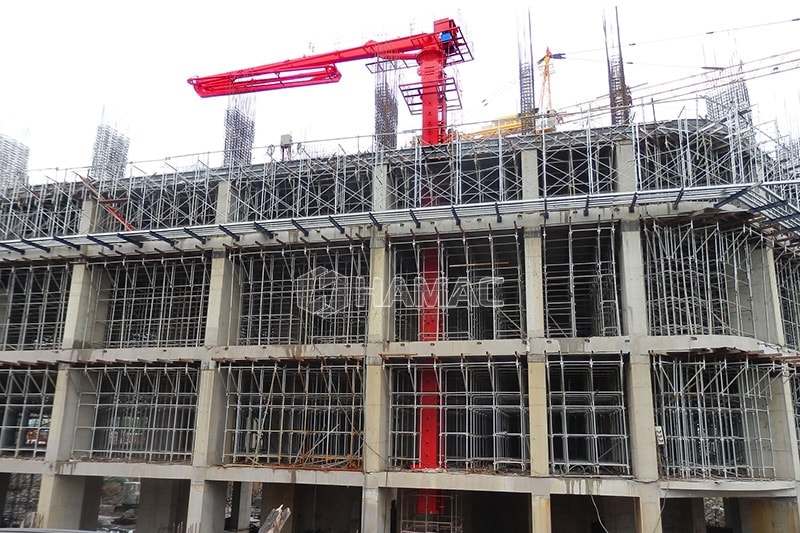
Self-climbing placing boom installed in the bulding
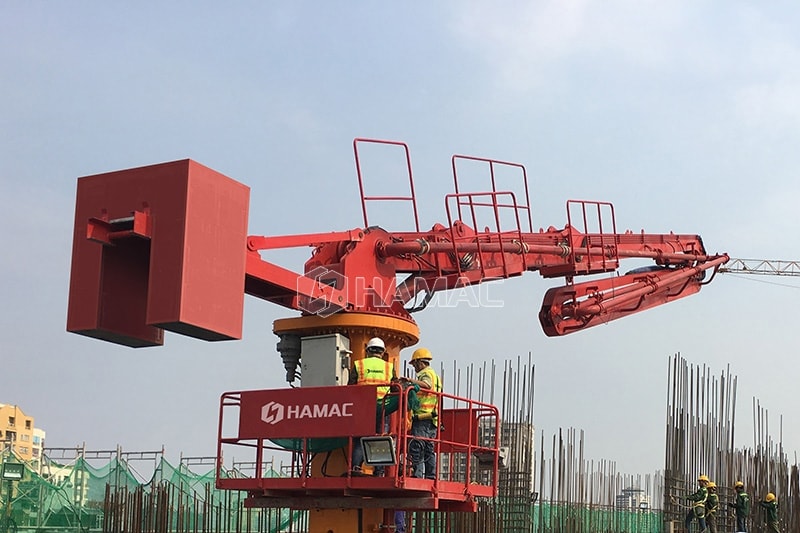
HGY32 concrete placing boom with counter weight
Need help applying this to your project?
Send your material type, target output and site conditions to HAMAC engineers. You will receive a practical equipment configuration and a clear quotation, normally within one working day.
Questions about this topic
How do I choose batching plant capacity?
Estimate the concrete volume per day, then divide by the effective working hours. Add 20 to 30 percent headroom for peak demand. A 35 m³/h plant suits small contractors; 50 to 75 m³/h suits commercial supply; 90 m³/h and above suits large projects.
Which mixer type should I choose for my concrete?
Twin-shaft compulsory mixers are the default for commercial concrete because of short mixing cycles and uniform output. Planetary mixers suit high-grade or special mixes, and drum mixers suit smaller, simpler operations.
How often should wear parts be replaced?
Mixer blades and liners are inspected weekly and normally replaced every 6 to 12 months depending on abrasive content. Belt scrapers, screen meshes and pump wear plates follow the same inspection rhythm.
Can the plant be upgraded later?
Yes. Modular batching plants allow additional silos, a larger mixer or an upgraded control system to be added later without replacing the whole structure.
Keep reading
All news
Related articles
 Exhibitions
HAMAC Highlights Concrete and Aggregate Equipment Solutions for Construction Projects
HAMAC Highlights Concrete and Aggregate Equipment Solutions for Construction Projects Equipment portfolio covers concrete production, mixing
Read more Trade News
HAMAC Trailer Concrete Mixer Pump for Foundation Construction in Peru
Explore how a HAMAC trailer concrete mixer pump supports foundation construction in Peru. See how integrated concrete mixing, pumping and pip
Read more Company News
HAMAC Showcases Group Strength and Concrete Solutions at EXCON 2026
HAMAC showcases its concrete equipment solutions at EXCON 2026 in Peru, with Group leadership, Manager Teo and Peru branch head Carol highlig
Read more