Exhibitions are expensive for exhibitors and time-consuming for visitors. Both sides benefit from the same discipline: a clear objective and a specific set of questions.
Following up after the show
The value of a show is realised in the two weeks after it closes. Notes taken at the stand, matched with the business cards collected and followed by a specific request, convert far more often than a general email sent a month later.
A useful follow-up refers to the conversation: the configuration discussed, the reference plant mentioned, the question that remained open. It shows the supplier that the meeting was worth having and it moves the discussion towards a quotation.
Booth design and what it signals
A booth is a compressed statement about the company. Clean machines, readable specifications, a place to sit and a team that can answer technical questions signal an organised supplier. A booth dominated by banners and without a technical person present signals the opposite.
The most effective displays let a visitor inspect the details that matter: a mixer trough section, a control panel, a weld sample and a wear part. These are the objects that generate real technical conversation.
Stage
Action
Output
Before
Shortlist exhibitors and questions
Visit plan
Before
Prepare technical specification
One page brief
During
Compare on identical rows
Comparison sheet
During
Request two references
Contact list
After
Follow up within two weeks
Quotation request
Stationary concrete batching plant with aggregate bins and cement silos — HAMAC equipment supplied to concrete and aggregate projects worldwide.
Regional shows versus international flagship events
A flagship international show gathers the whole industry and is efficient for comparing technology, but it is expensive and crowded. A regional show attracts the buyers who actually work in that market, and a conversation there often moves faster because the project is local.
For a buyer, the practical combination is one large show every few years to survey the market and regional shows for specific projects. For a supplier, the same logic applies in reverse when choosing where to exhibit.
Show calendar planning for the coming year
Construction equipment exhibitions cluster around a few established dates: the large international events rotate on a multi-year cycle, while regional shows repeat annually. Planning a calendar 12 months ahead avoids clashes between two useful events in the same month.
Budget should include travel, accommodation, sample transport and follow-up time. The follow-up is the item most often left out of the budget, and it is the one that determines whether the show produces orders.
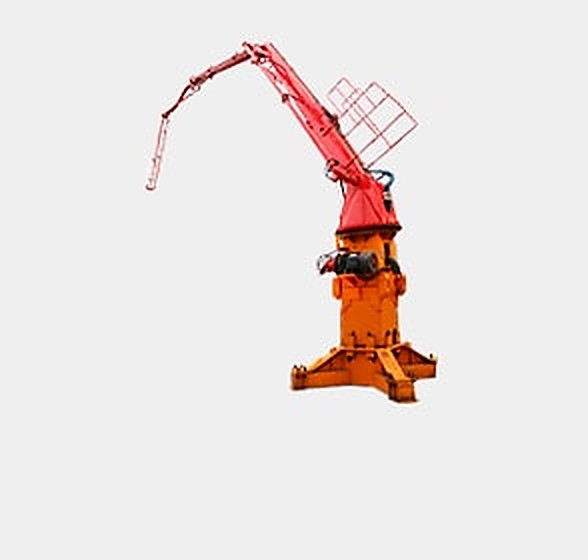
Self climbing concrete placing boom installed on a high-rise frame — HAMAC equipment supplied to concrete and aggregate projects worldwide.
Setting objectives before the show
A trade show visit produces results only when the objective is defined in advance. That may be to compare three suppliers for a specific plant, to find a distributor for a region or to see a new machine type in operation. Each objective implies a different plan for which stands to visit and what to ask.
Visitors who arrive without a list spend most of their time on the largest stands and leave with brochures rather than decisions. A short list of target exhibitors, prepared from the show catalogue, is the most useful preparation.
Questions that reveal real capability
Brochure figures are not comparable between suppliers. Ask about steel plate thickness, gearbox brand and model, load cell type, control system architecture and the scope included in the quoted price. These five answers separate suppliers more reliably than any other question.
Ask also for two references in similar conditions and for the name of the service partner in your region. A supplier who cannot answer those questions at the show is unlikely to answer them after the order.
What live demonstrations show
A live demonstration reveals things a static display cannot: noise level, cycle speed, the smoothness of a mixer discharge, the quality of the weld on a visible joint and how the control system behaves in real time.
Watch the operators as much as the machine. A confident operator, a clean machine and a well-organised demonstration area indicate a supplier that pays attention to detail in the factory as well.
Where to go next
For the equipment side, see project references; for plant-level design and layout questions, see equipment catalogue. If the project is in Ghana or a comparable market, the HAMAC team can provide reference installations and a configuration proposal against your daily output target.
If you are comparing configurations, share the requirement with HAMAC and ask for a like-for-like quotation with the included scope listed item by item.
Need help applying this to your project?
Send your material type, target output and site conditions to HAMAC engineers. You will receive a practical equipment configuration and a clear quotation, normally within one working day.
Questions about this topic
Which trade shows does HAMAC attend?
HAMAC exhibits at construction and machinery shows in Asia, Africa, the Middle East and Latin America, including Bauma, EXCON, BATEV and BATIMATEC.
Will the machines shown be available for demonstration?
Selected machines are available for live demonstration at larger shows, with video walkthroughs where a live demonstration is not possible.
How do I compare two machines at a show?
Use the same comparison rows for both: mixer volume and type, batching accuracy, control level, steel thickness, included scope and delivery time.
H
HAMAC Machinery Editorial Team
Written and reviewed by engineers and sales specialists who configure concrete batching plants, crushers, mixers and pumps for projects in more than 180 countries. Content is based on factory testing data and field feedback from delivered equipment.





 Company News

